View the example grid
A Hidden Single occurs when a digit has only one possible place in a row, column or box. The cell itself can still have other candidates.
An example from the app
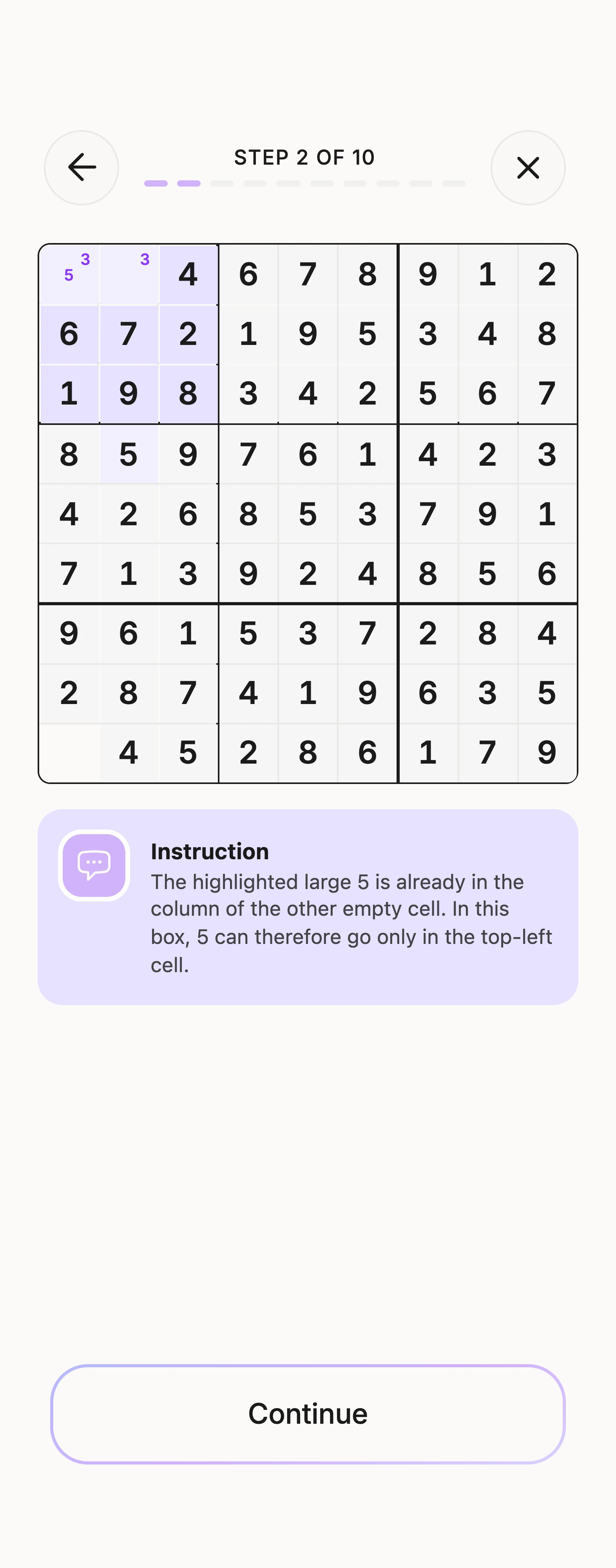
This 3×3 box is missing 3 and 5. Both are candidates for its top-left cell. We will now check where the 5 can go in this box.
The highlighted large 5 is already in the column of the other empty cell. In this box, 5 can therefore go only in the top-left cell.
Practice the next step
Track that digit throughout the whole area. This differs from looking for a cell with only one candidate.
In the app, follow the reasoning in the matching lesson and try a task yourself. With a new puzzle, always start from its actual candidate state.
Questions about Hidden Single
Why is it hidden if the cell contains several notes?
The digit has only this position in the area. The cell’s other notes merely conceal that unique position.
Where should I count a digit’s positions?
Across a complete row, column or box. An arbitrary fragment of the grid is not sufficient.
Do I need every candidate in that area?
You must consider every actual position of the digit. Overlooking one can create a false Hidden Single.
How is it different from Naked Single?
Naked Single gives a cell one possible digit. Hidden Single gives a digit one possible position in an area.
What if the digit can still occupy two cells?
It is not a Hidden Single in that area. Check other areas or other candidate relationships.
Keep practicing in Unisu
Download Unisu for iPhone or Android. Solve a puzzle or work through a guided lesson on the technique.