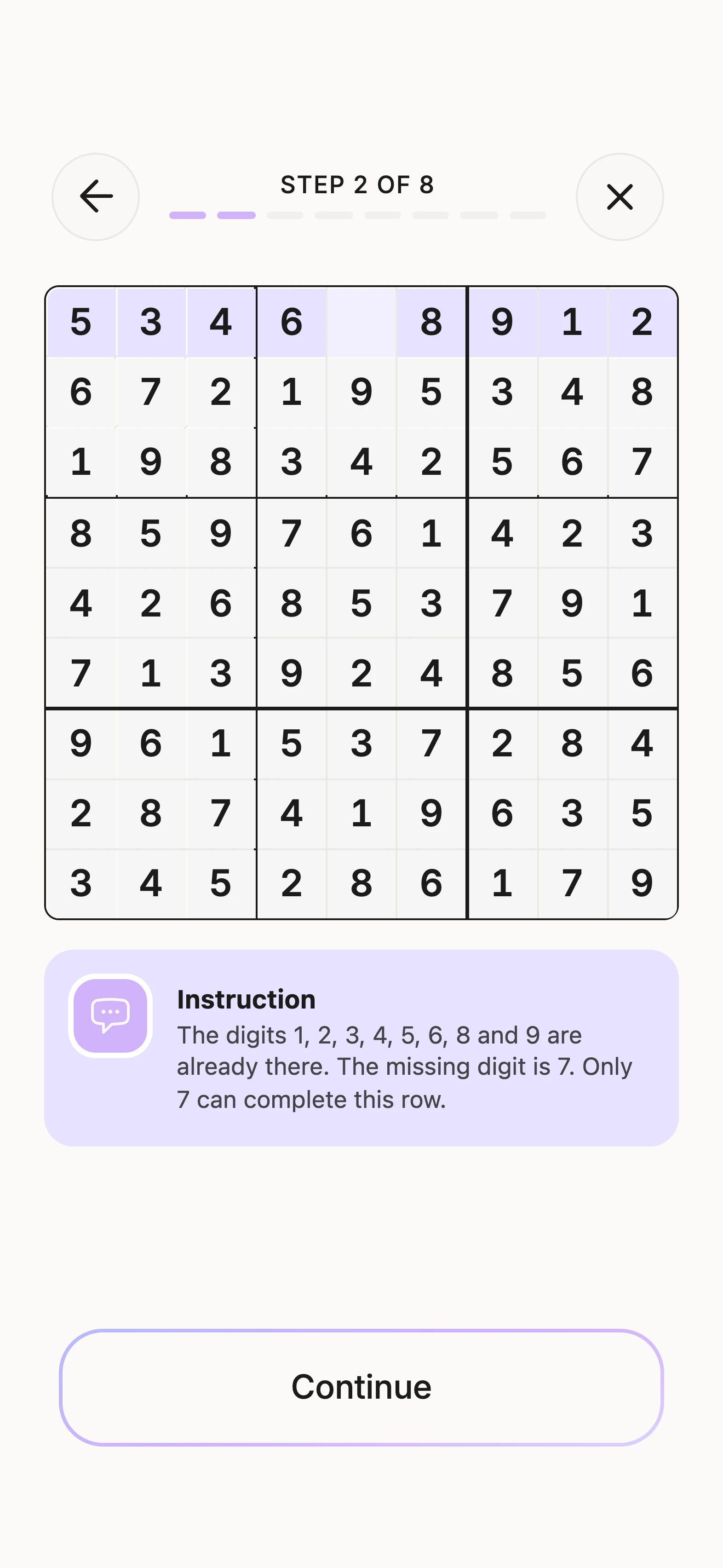
View the example grid
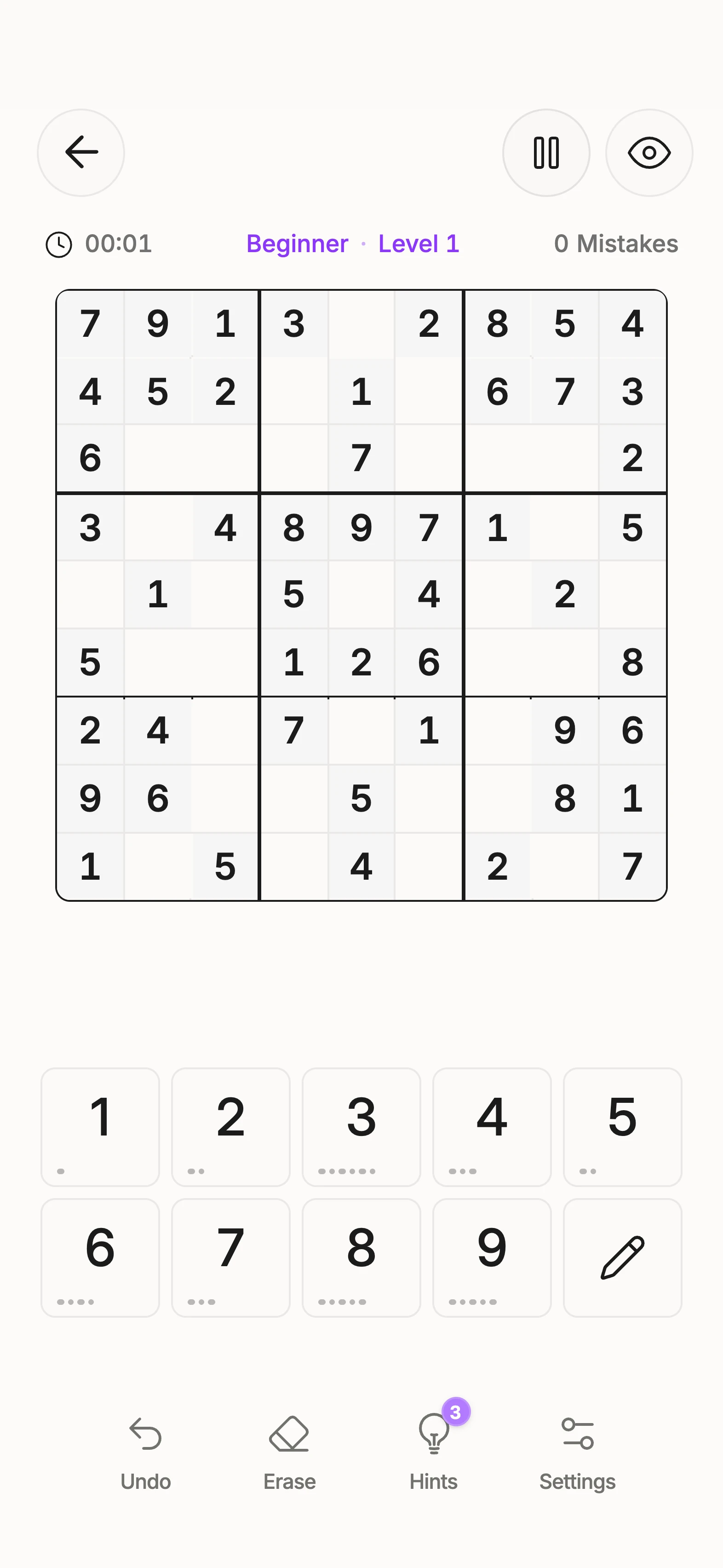
Sudoku is a logic puzzle. The digits 1 to 9 are symbols for different possibilities. You don’t need arithmetic to solve it.
The three rules
Fill the 9×9 grid so that each digit from 1 to 9 appears exactly once in every row, every column and each of the nine 3×3 boxes. The given numbers stay fixed. A move must respect all three areas around its cell.
A row with one gap
The first row in the example reads 5, 3, 4, 6, a gap, 8, 9, 1 and 2. The only missing digit is 7, so it belongs in the fifth cell. This situation is called Full House.
A second 5 would break the row rule. When several cells are empty, a number missing from the row is not enough to decide where it goes: check each cell’s column and box as well.
What comes next?
Look for other rows, columns and boxes with one gap. Where several possibilities remain, pencil marks and the two single techniques help you reason further. There is no need to memorize a complete solution path.
Frequently asked questions
Do the diagonals need every digit too?
Classic Sudoku applies the rules to rows, columns and 3×3 boxes. Diagonals are not additional areas that must contain each digit once.
Do I need arithmetic to play Sudoku?
No. The digits represent nine different values. You reason about which values are present and which positions remain possible.
Can I change the given digits?
The givens belong to the puzzle and stay fixed. Fill the empty cells while respecting all three rules.
Where should I start on an almost full grid?
Look for a row, column or box with one empty cell. Its one missing digit already has a fixed place.
What if several digits are still possible?
Note the allowed candidates and examine the other areas. A possibility is not yet a justified placement.
Keep practicing in Unisu
Download Unisu for iPhone or Android. Solve a puzzle or work through a guided lesson on the technique.