View the example grid
A Hidden Triple occurs when three digits have only three possible cells between them in a row, column or box. Extra candidates in those cells can be removed.
An example from the app
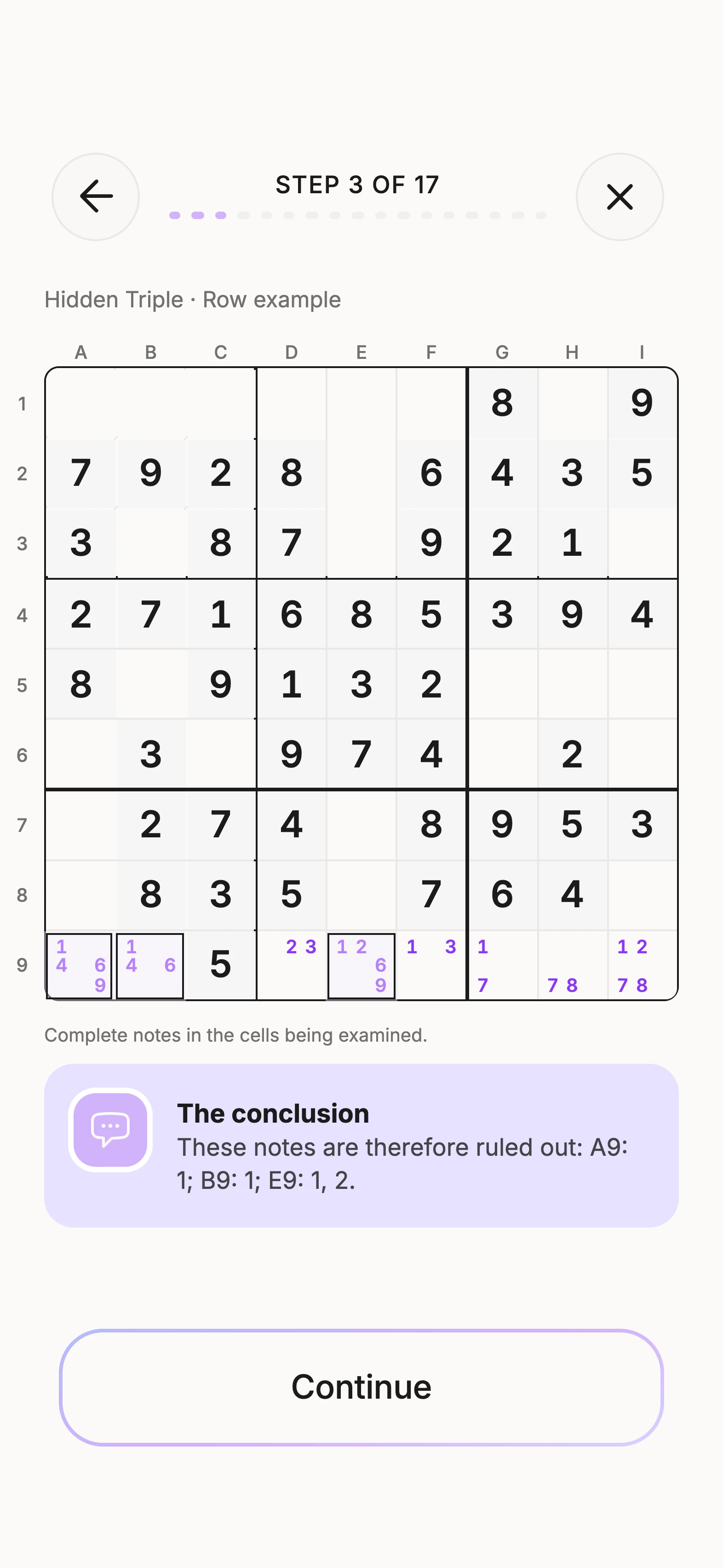
In row 9, the digits 4, 6, 9 occur as candidates only in the 3 highlighted cells A9, B9, E9. Those cells also contain other notes.
Those 3 digits need exactly those 3 cells. The extra candidates in those cells cannot be true. The removals happen inside the highlighted group.
These notes are therefore ruled out: A9: 1; B9: 1; E9: 1, 2.
The image shows the candidates relevant to this step. A note being hidden does not mean it has been logically eliminated.
Practice the next step
Check all occurrences of the three digits across the area. The eliminations are inside the marked group.
In the app, follow the reasoning in the matching lesson and try a task yourself. With a new puzzle, always start from its actual candidate state.
Questions about Hidden Triple
What does a Hidden Triple reserve?
Three digits are restricted to three cells within an area. Those cells are needed for those digits.
Must each digit occur in all three cells?
No. The occurrences can differ. All positions of the three digits together must occupy exactly those three cells.
Which notes can I remove?
Other candidates within the three reserved cells. This pattern does not justify those eliminations outside the group.
What if there is a fourth possible cell?
The restriction to three cells is no longer established. Check the complete candidates across the area.
How is it different from Naked Triple?
Naked Triple has three cells containing only three digits between them. Extra notes can initially conceal the digits of a Hidden Triple.
Keep practicing in Unisu
Download Unisu for iPhone or Android. Solve a puzzle or work through a guided lesson on the technique.