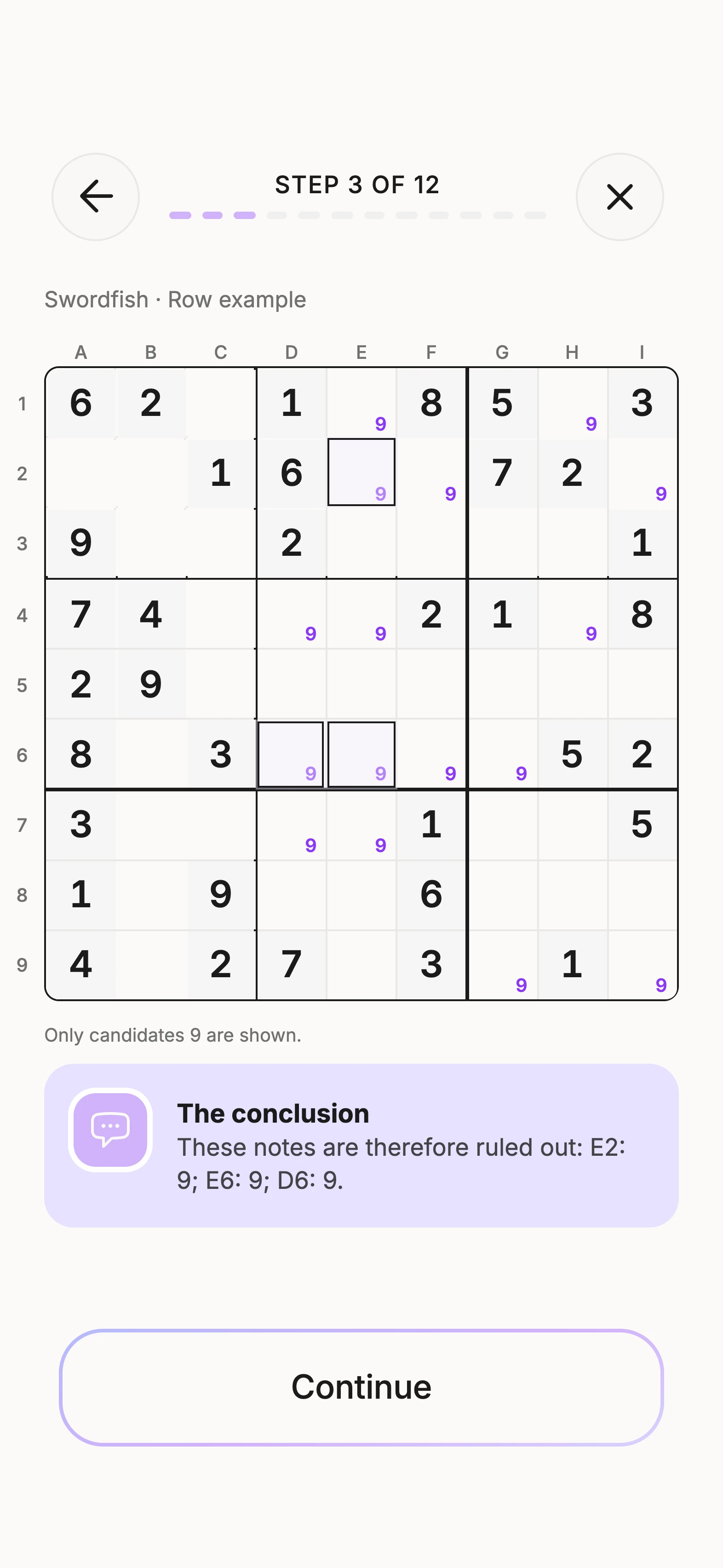
View the example grid
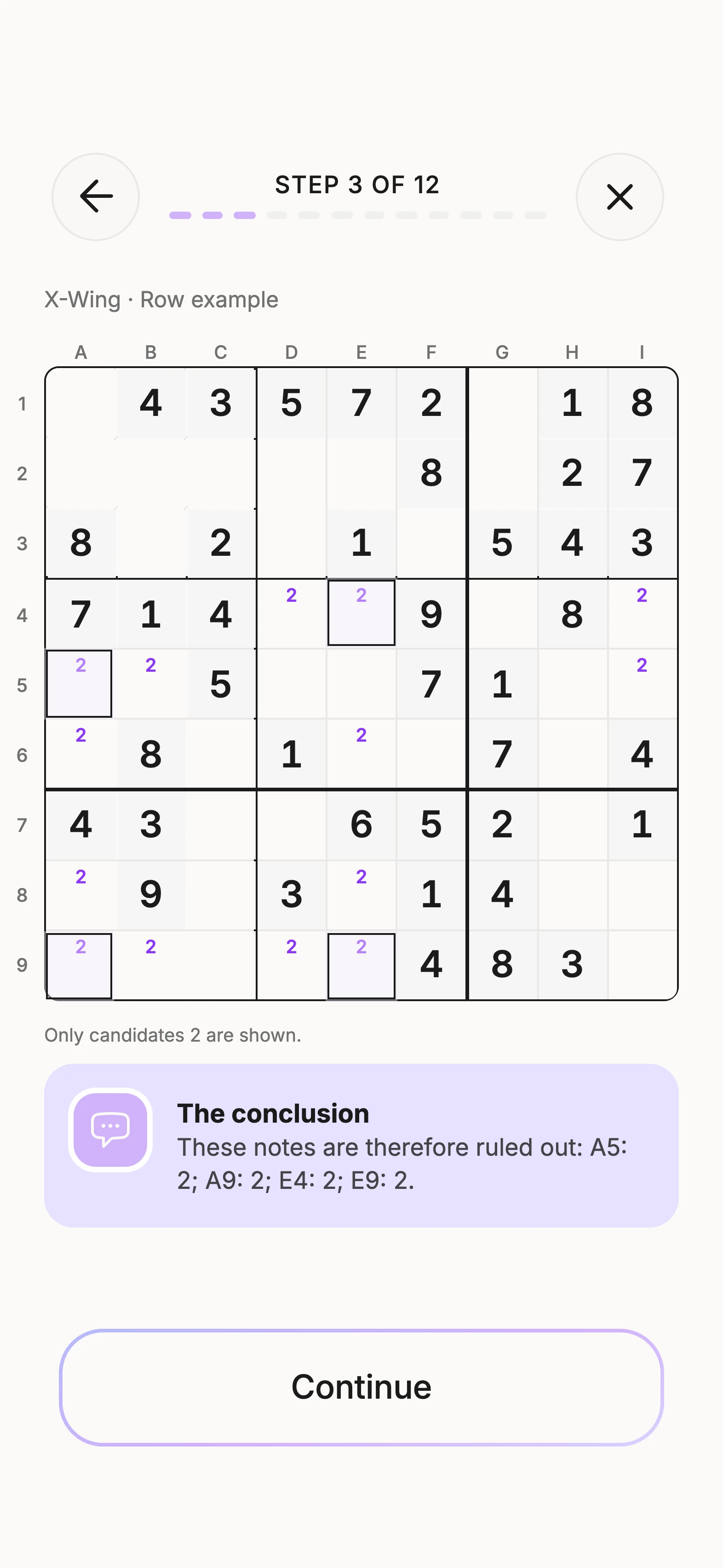
An X-Wing occurs when a digit has exactly two possible cells in each of two rows, in the same two columns. The digit can be removed from other cells in those columns.
An example from the app
In row 6, row 8, candidate 2 is confined to column A, column E. There are 2 starting lines and exactly 2 crossing lines.
The 2 required placements of 2 occupy column A, column E. In those lines, 2 is ruled out outside row 6, row 8.
These notes are therefore ruled out: A5: 2; A9: 2; E4: 2; E9: 2.
The image shows the candidates relevant to this step. A note being hidden does not mean it has been logically eliminated.
Practice the next step
A rectangle alone is not enough. The two starting rows must have no other candidates for that digit.
In the app, follow the reasoning in the matching lesson and try a task yourself. With a new puzzle, always start from its actual candidate state.
Questions about X-Wing
Are four candidates forming a rectangle enough?
No. Each starting row must allow the digit only in the same two columns.
Where can I eliminate in a row-based X-Wing?
In the two cover columns outside the starting rows. The four starting positions remain reserved for the digit.
Can I start an X-Wing from columns instead?
Yes. Two columns become the starting areas and two rows the cover areas; the elimination direction changes accordingly.
Do the cells’ other candidates matter?
This pattern follows one digit. Other candidates do not invalidate it if the restrictions for that digit hold.
How does Swordfish differ?
Swordfish uses three starting areas and three cover areas. X-Wing uses two of each.
Keep practicing in Unisu
Download Unisu for iPhone or Android. Solve a puzzle or work through a guided lesson on the technique.