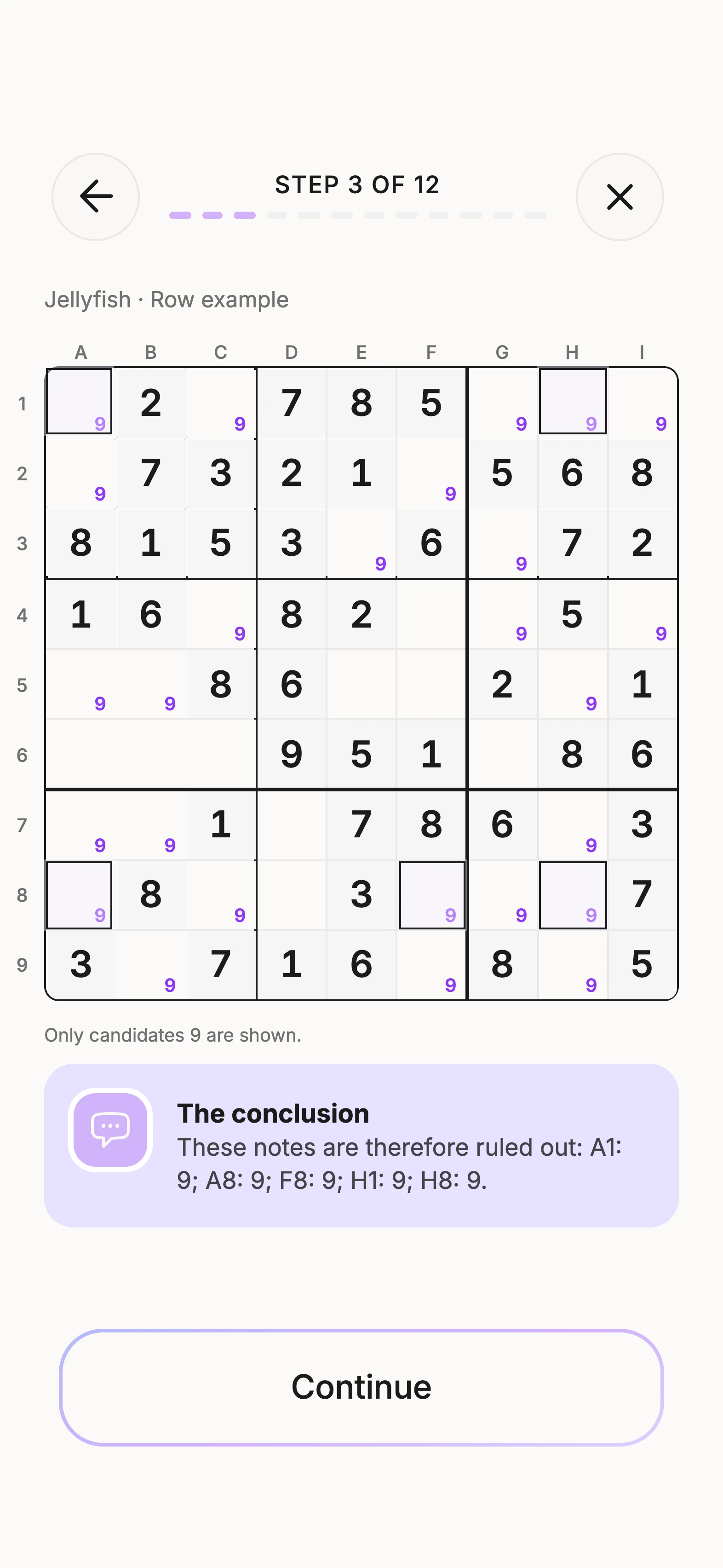
View the example grid
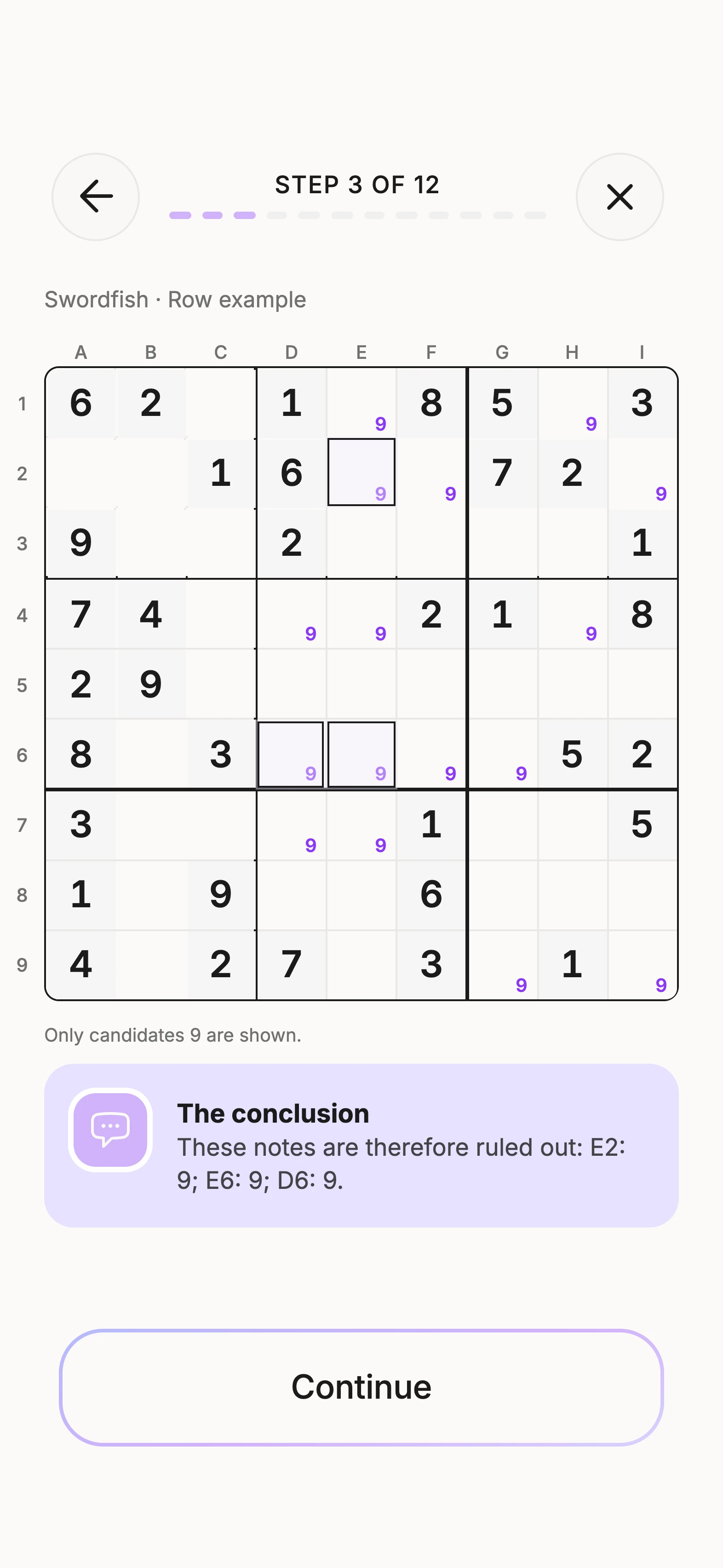
A Swordfish confines a digit’s candidates in three starting rows to exactly three columns. The three required placements use those columns.
An example from the app
In row 1, row 4, row 7, candidate 9 is confined to column E, column H, column D. There are 3 starting lines and exactly 3 crossing lines.
The 3 required placements of 9 occupy column E, column H, column D. In those lines, 9 is ruled out outside row 1, row 4, row 7.
These notes are therefore ruled out: E2: 9; E6: 9; D6: 9.
The image shows the candidates relevant to this step. A note being hidden does not mean it has been logically eliminated.
Practice the next step
There must be no candidates for the digit outside those columns in the starting rows. Each row does not have to contain three candidates.
In the app, follow the reasoning in the matching lesson and try a task yourself. With a new puzzle, always start from its actual candidate state.
Questions about Swordfish
Does every starting row need three candidates?
No. Some rows can have fewer positions. Together, all positions of the digit in the three rows must be limited to three cover columns.
Must Swordfish form a regular rectangle?
No. The three starting and cover areas matter, not a completely filled geometric shape.
Where do row-based Swordfish eliminations occur?
In the three cover columns outside the three starting rows. Those positions cannot hold the digit.
Can Swordfish start with columns?
Yes. Rows and columns exchange roles, while the restriction to three cover areas stays the same.
What makes Jellyfish different?
Jellyfish uses four starting and four cover areas. Check smaller patterns before tracking four areas at once.
Keep practicing in Unisu
Download Unisu for iPhone or Android. Solve a puzzle or work through a guided lesson on the technique.