View the example grid
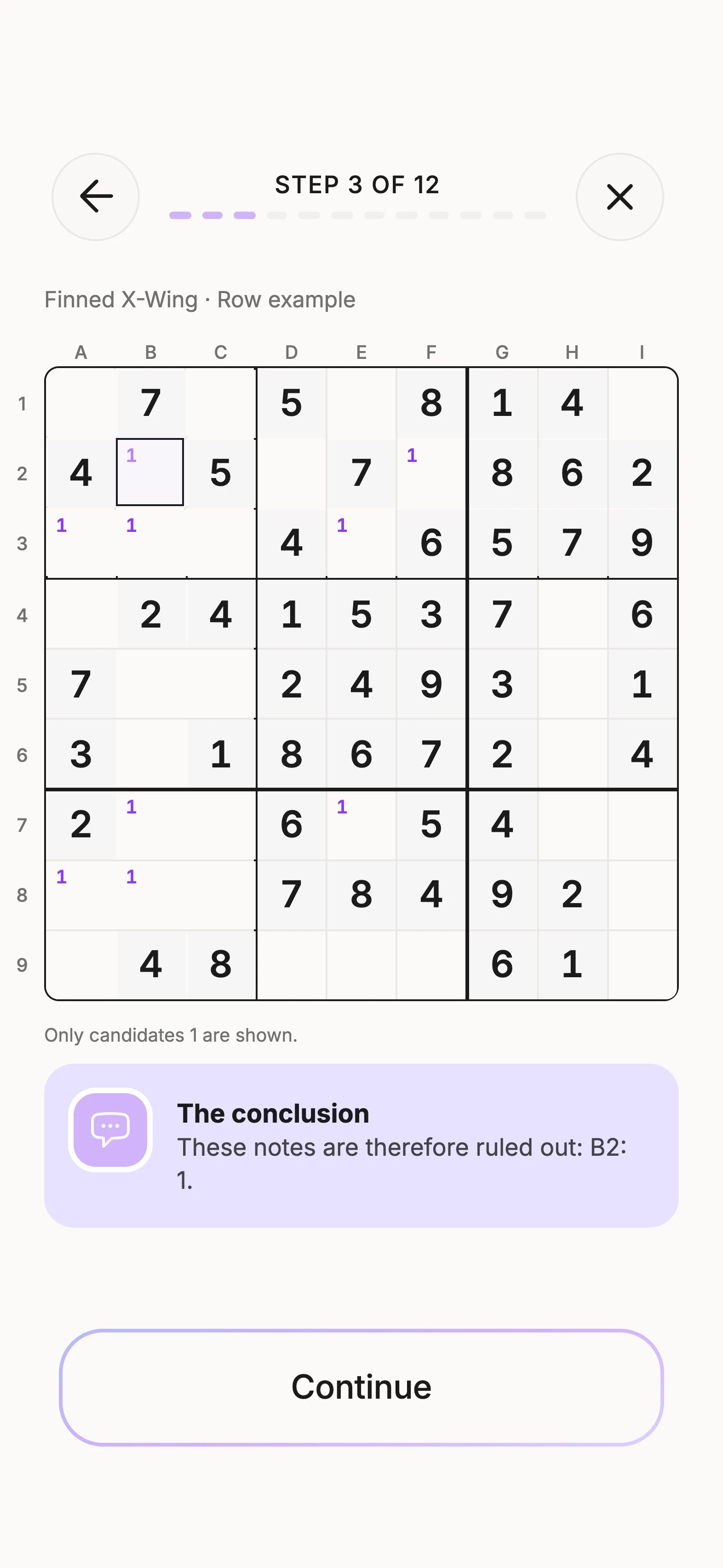
A Finned X-Wing adds extra candidates in one box, called the fin, to the basic pattern. An elimination must conflict both with the fin and with the X-Wing that remains if the fin is false.
An example from the app
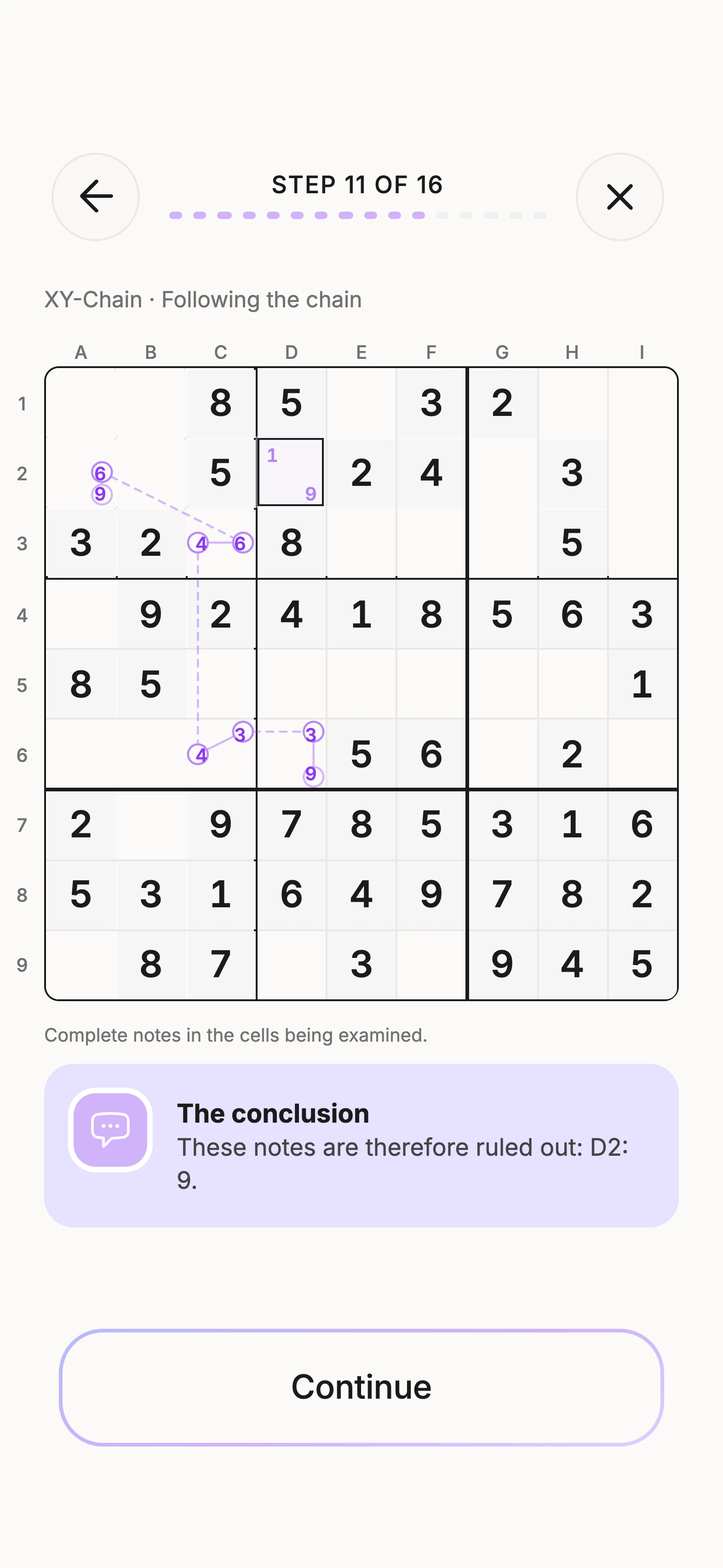
Candidate 1 forms a rectangle in row 7, row 3 across column B, column E. The fins in A3 add extra positions, all in box 1.
Without 1 in fins A3, the ordinary X-Wing applies. With 1 in a fin, box 1 blocks the same targets. Either way, 1 is ruled out in B2.
These notes are therefore ruled out: B2: 1.
The image shows the candidates relevant to this step. A note being hidden does not mean it has been logically eliminated.
Practice the next step
Targets are restricted to the fin’s box and the relevant cover line. This guide uses the supported non-sashimi form.
In the app, follow the reasoning in the matching lesson and try a task yourself. With a new puzzle, always start from its actual candidate state.
Questions about Finned X-Wing
What is the fin in Finned X-Wing?
An extra position for the digit beside the basic X-Wing. In the illustrated form, the fins share one box.
Can I ignore the fin while looking for eliminations?
No. The target must be excluded both when a fin holds the digit and when the ordinary X-Wing remains.
Where may I eliminate in this example?
At suitable positions of the cover line inside the fin’s box, outside the starting rows. Both cases exclude the digit there.
Can any extra note serve as a fin?
No. It must satisfy the required area and visibility relationships. An arbitrary extra candidate beside a rectangle is not enough.
Does this explain every Sashimi form too?
No. This introduction covers the supported non-Sashimi form. Do not transfer its eliminations to a different pattern without checking the logic.
Keep practicing in Unisu
Download Unisu for iPhone or Android. Solve a puzzle or work through a guided lesson on the technique.