View the example grid
Nishio tests one candidate assumption using forced deductions. If it leaves a cell with no possibility, or a required digit with no place, the assumption is false.
An example from the app
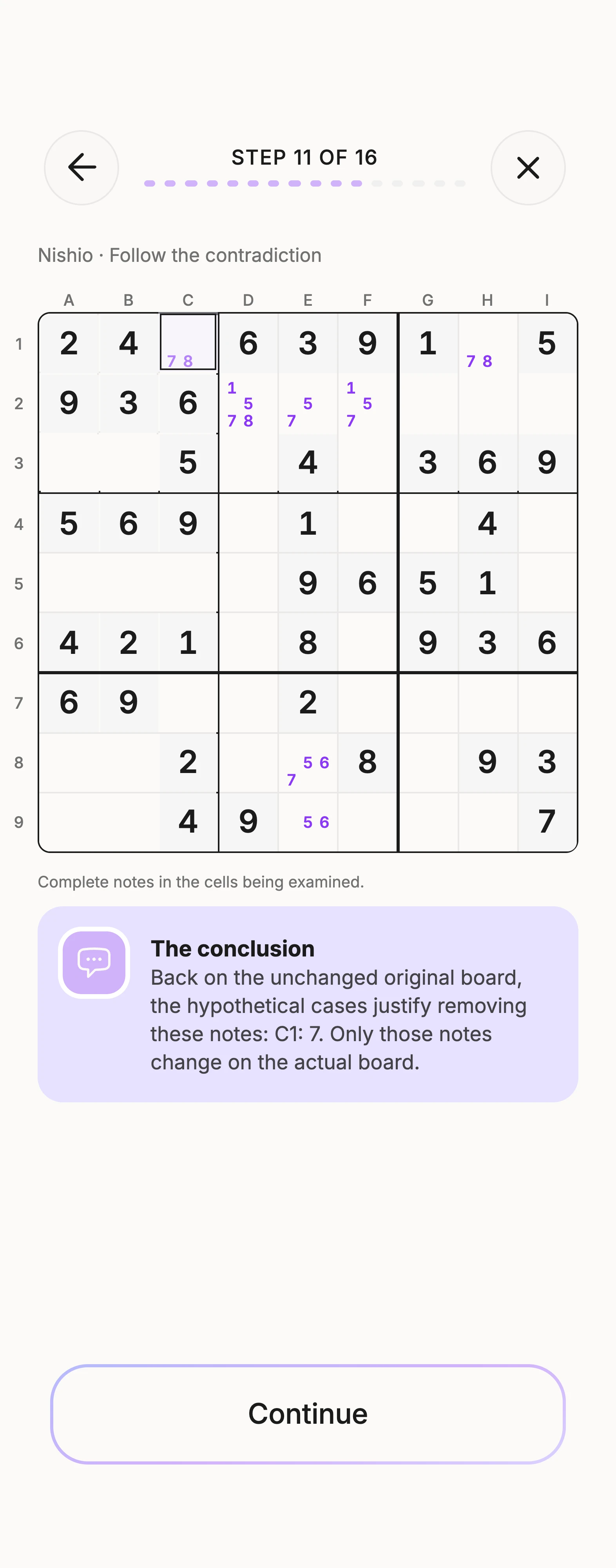
We examine candidate 7 in C1. For now, we only assume it is true. Every further entry in the preview depends on that assumption.
We follow only forced Naked and Hidden Singles. If a cell later has no possibility or a required digit has no place, the assumption is disproved. The preview is then discarded completely.
Only hypothetically, assume C1 = 7 and follow the resulting singles. The actual grid is not changed.
Under this assumption, only 8 remains possible in H1. This Naked Single is entered in the hypothetical grid.
Under this assumption, 8 has only one place in row 2: D2. This Hidden Single is entered in the hypothetical grid.
Under this assumption, 1 has only one place in row 2: F2. This Hidden Single is entered in the hypothetical grid.
Under this assumption, 5 has only one place in row 2: E2. This Hidden Single is entered in the hypothetical grid.
Under this assumption, only 6 remains possible in E9. This Naked Single is entered in the hypothetical grid.
Under this assumption, only 7 remains possible in E8. This Naked Single is entered in the hypothetical grid.
The required 7 now has no place in row 7. This is a contradiction, so the original assumption was false.
Back on the unchanged original grid, the hypothetical cases justify removing these notes: C1: 7. Only those notes change on the actual grid.
The image shows the candidates relevant to this step. A note being hidden does not mean it has been logically eliminated.
Practice the next step
Unisu’s version follows only Naked Single and Hidden Single. Return to the unchanged starting grid and remove only the disproved candidate.
In the app, follow the reasoning in the matching lesson and try a task yourself. With a new puzzle, always start from its actual candidate state.
Questions about Nishio
What does Nishio assume?
One candidate is provisionally treated as true. All following steps depend on that assumption and leave the real game state unchanged.
What counts as a contradiction?
For example, a cell with no candidate or a required digit with no position in an area. This disproves the starting assumption.
Does running out of Singles disprove a branch?
No. Being stuck is not a contradiction. Without a real contradiction, you cannot remove the assumed candidate.
What changes may I apply afterwards?
Only the justified elimination of the disproved starting candidate. Discard the hypothetical entries made along the way.
How does it differ from Forcing Chain?
Nishio disproves a single assumption. The Forcing Chain shown here compares two possibilities and uses their common conclusion.
Keep practicing in Unisu
Download Unisu for iPhone or Android. Solve a puzzle or work through a guided lesson on the technique.