View the example grid
A Forcing Chain explores both candidates of a cell in separate hypothetical branches. If both imply the same elimination, it holds without choosing between them.
Two cells see each other when they share a row, column or 3×3 box. An elimination needs the specific visibility relationships described in the reasoning.
An example from the app
Cell C7 has only candidates 6, 8. Exactly one must be true. We will test both possibilities in turn without choosing one as the answer.
Each assumption can force further Naked Singles. We then compare the ruled-out candidates. Only exclusions shared by both cases may be applied to the original grid.
Only hypothetically, assume C7 = 6 and follow the resulting singles. The actual grid is not changed.
Under this assumption, only 4 remains possible in C2. This Naked Single is entered in the hypothetical grid.
Under this assumption, only 7 remains possible in C3. This Naked Single is entered in the hypothetical grid.
Under this assumption, only 1 remains possible in C1. This Naked Single is entered in the hypothetical grid.
Under this assumption, only 5 remains possible in B1. This Naked Single is entered in the hypothetical grid.
Under this assumption, only 4 remains possible in I1. This Naked Single is entered in the hypothetical grid.
Under this assumption, only 2 remains possible in D1. This Naked Single is entered in the hypothetical grid.
Under this assumption, only 7 remains possible in E1. This Naked Single is entered in the hypothetical grid.
Under this assumption, only 8 remains possible in B7. This Naked Single is entered in the hypothetical grid.
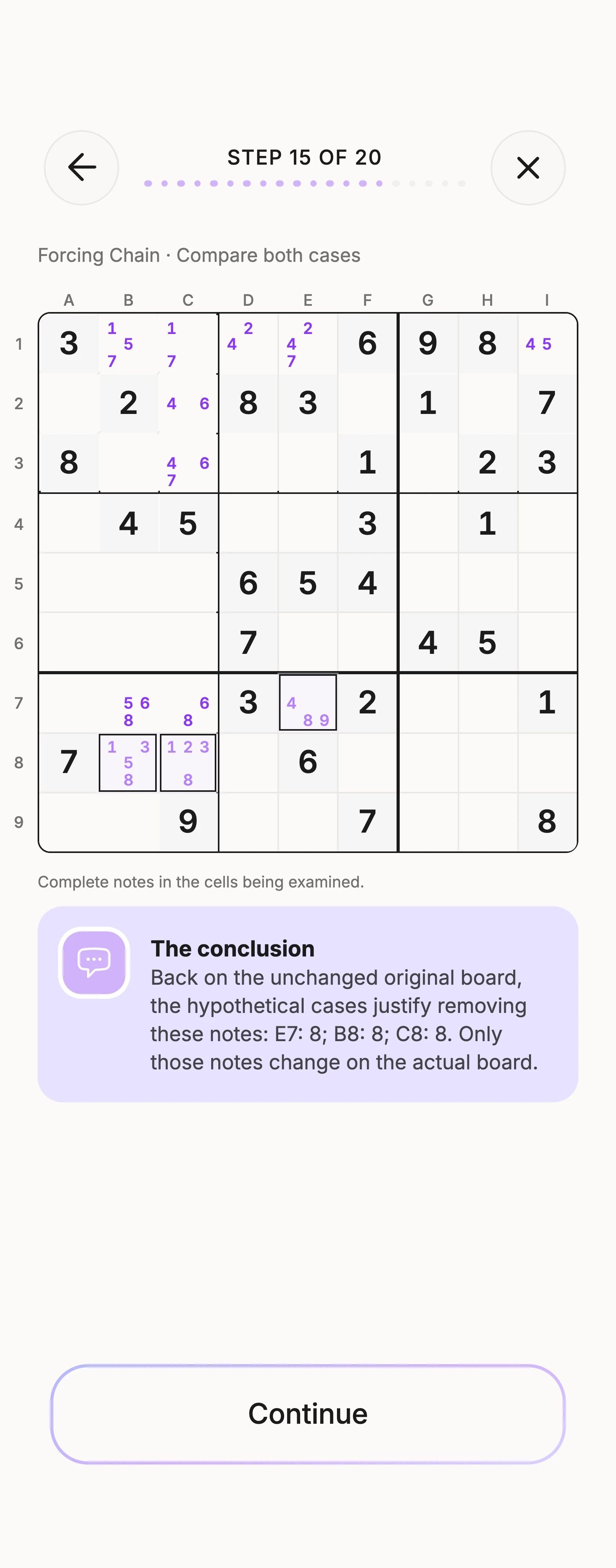
In this case, these notes are impossible: E7: 8; B8: 8; C8: 8.
Return to the original grid. In the second hypothetical case, assume C7 = 8 instead. The first case’s entries are not carried over.
Back on the unchanged original grid, the hypothetical cases justify removing these notes: E7: 8; B8: 8; C8: 8. Only those notes change on the actual grid.
The image shows the candidates relevant to this step. A note being hidden does not mean it has been logically eliminated.
Practice the next step
Only forced moves may advance a branch. The previews do not change the starting grid; only the justified shared result is applied.
In the app, follow the reasoning in the matching lesson and try a task yourself. With a new puzzle, always start from its actual candidate state.
Questions about Forcing Chain
Is a Forcing Chain just guessing?
No. Both possibilities are examined separately with explicit reasoning. Only a conclusion independent of the initial choice is applied.
Why start the example with two candidates?
The two branches must cover every possibility in the starting cell. An unexamined third candidate would prevent that conclusion.
Which moves can advance a branch?
Only forced moves, not another free assumption. The example follows the Naked Single steps that result.
Is elimination in one branch enough?
No. The same elimination must hold in both cases to establish the common conclusion.
Do the first branch’s entries stay for the second branch?
No. The second branch starts from the unchanged original grid. Hypothetical entries are not real game moves.
Keep practicing in Unisu
Download Unisu for iPhone or Android. Solve a puzzle or work through a guided lesson on the technique.