View the example grid
A W-Wing starts with two cells containing the same two candidates. A strong link for one candidate connects them so that at least one cell must contain the other digit.
Two cells see each other when they share a row, column or 3×3 box. An elimination needs the specific visibility relationships described in the reasoning.
An example from the app
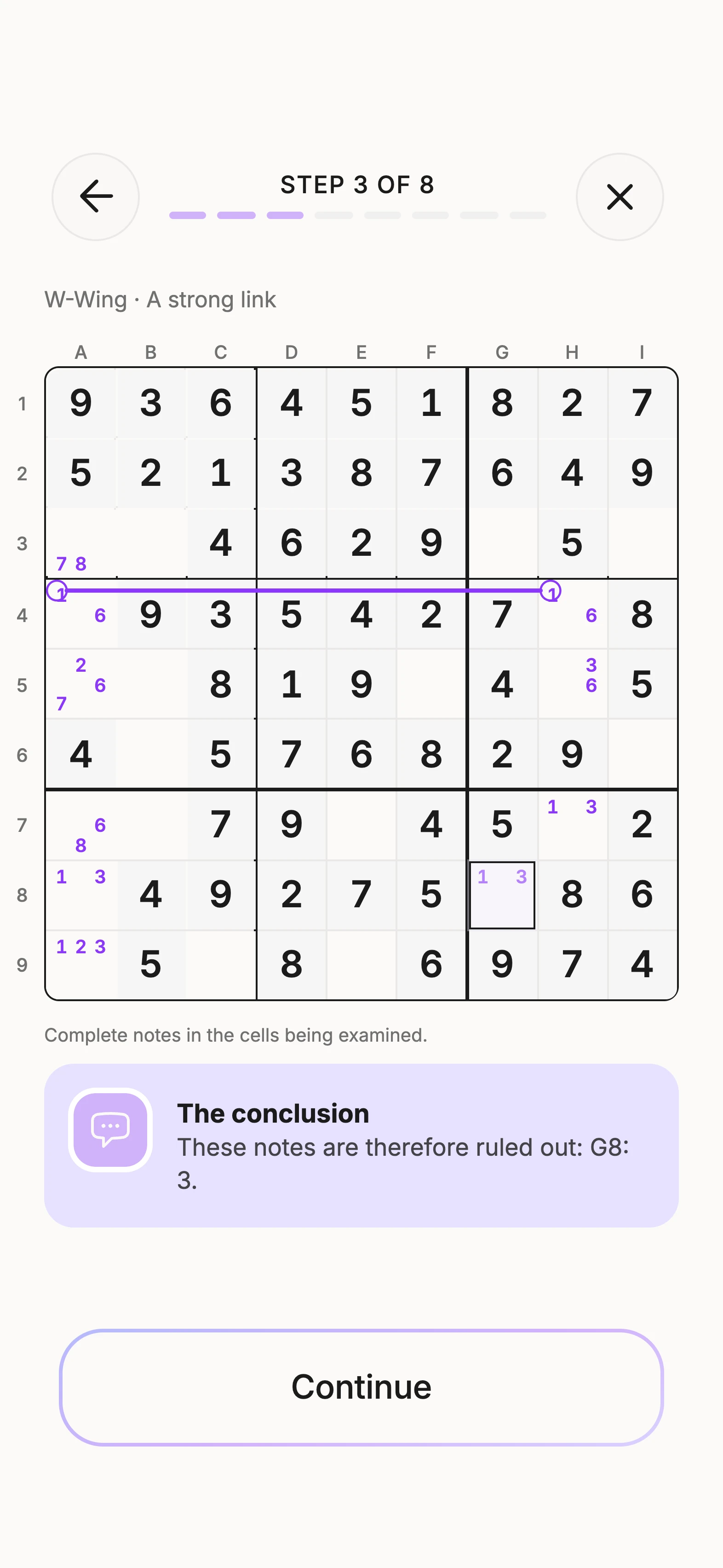
H7 and A8 both have only 1, 3. Also, 1 has exactly two places in row 4: A4 and H4. The solid line connects those two possibilities.
1 must be in A4 or H4. This removes it from at least one of H7 and A8, forcing that cell to be 3. Cells sharing a row, column or box with both cannot contain 3.
These notes are therefore ruled out: G8: 3.
The image shows the candidates relevant to this step. A note being hidden does not mean it has been logically eliminated.
Practice the next step
Matching pairs alone are not enough. You need the actual strong link and a target that sees both end cells.
In the app, follow the reasoning in the matching lesson and try a task yourself. With a new puzzle, always start from its actual candidate state.
Questions about W-Wing
Are two cells with the same pair sufficient?
No. W-Wing also needs the appropriate strong link for one digit of that pair.
What does strong link mean here?
An area has exactly two positions for the linking digit. At least one of those positions must contain it.
Must the two end cells see each other?
Not necessarily. Their relationships to the strong link, and the target’s view of both ends, are what matter.
Which digit of the pair is eliminated?
The other digit, rather than the one used by the strong link. Remove it only from valid targets seeing both ends.
Is W-Wing the same as XY-Wing?
No. W-Wing links two identical pairs through a strong relationship. XY-Wing uses a pivot and two wings with different pairs.
Keep practicing in Unisu
Download Unisu for iPhone or Android. Solve a puzzle or work through a guided lesson on the technique.