View the example grid
An XY-Wing connects a pivot cell X/Y to two cells it sees, X/Z and Y/Z. Whichever digit goes in the pivot, one wing must contain Z.
Two cells see each other when they share a row, column or 3×3 box. An elimination needs the specific visibility relationships described in the reasoning.
An example from the app
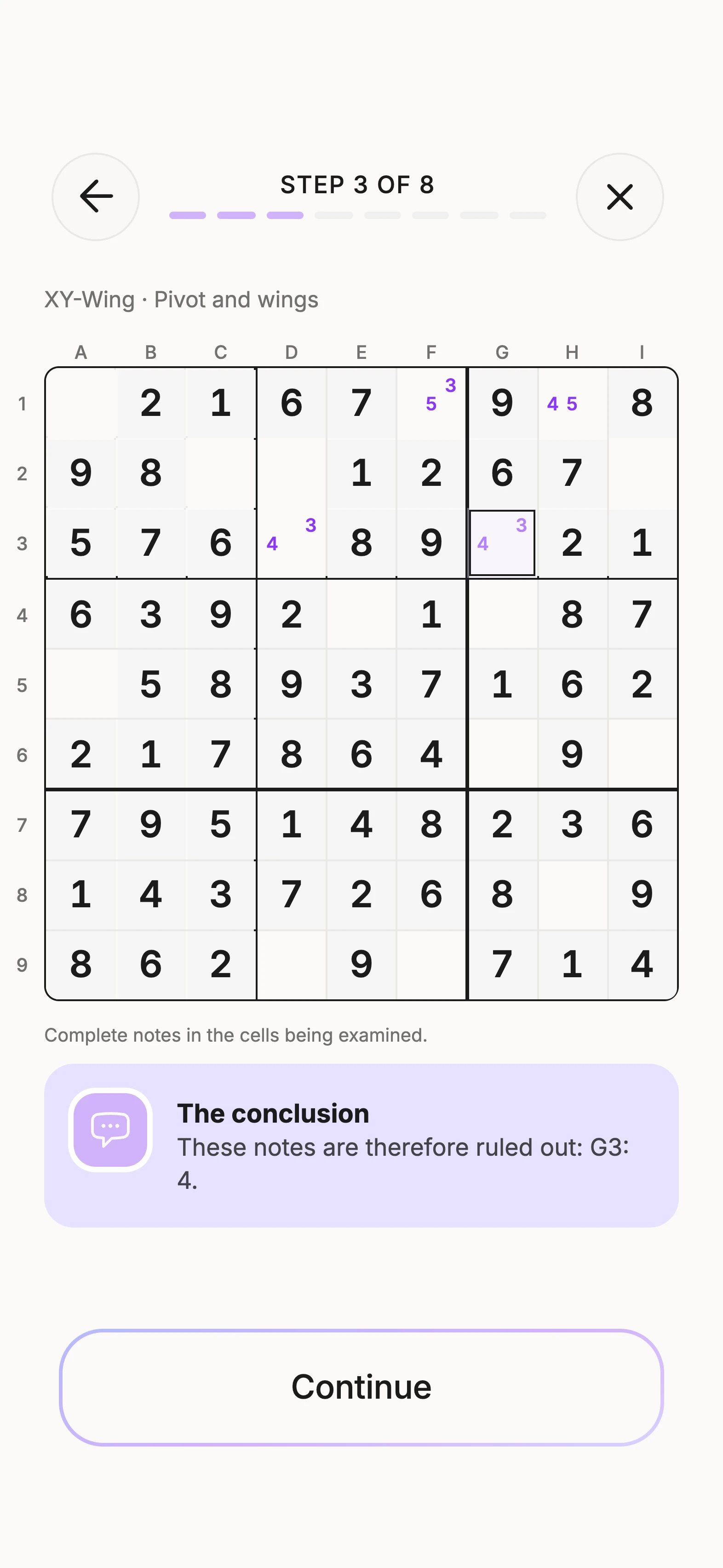
Pivot F1 has 5 and 3. Its wings are H1 with 5, 4, and D3 with 3, 4. Each wing shares a row, column or box with the pivot.
If F1 is 5, H1 must be 4. If F1 is 3, D3 must be 4. At least one wing contains it. A cell sharing a row, column or box with each wing cannot contain 4.
These notes are therefore ruled out: G3: 4.
The image shows the candidates relevant to this step. A note being hidden does not mean it has been logically eliminated.
Practice the next step
Remove Z only from cells that see both wings. Seeing the pivot alone is not enough.
In the app, follow the reasoning in the matching lesson and try a task yourself. With a new puzzle, always start from its actual candidate state.
Questions about XY-Wing
How many candidates do the XY-Wing cells have?
Exactly two each: X/Y at the pivot, with X/Z and Y/Z in the wings. The full candidate lists must match.
Must the wings see each other?
No. Each wing must see the pivot. An elimination target must see both wings.
Must the target also see the pivot?
Not for XY-Wing. Seeing both wings is what matters for eliminating their common digit Z.
Which digit is eliminated?
The common wing digit Z. Either choice at the pivot forces Z into at least one wing.
How is XYZ-Wing different?
XYZ-Wing has three candidates at its pivot. Its elimination target must see the pivot as well as both wings.
Keep practicing in Unisu
Download Unisu for iPhone or Android. Solve a puzzle or work through a guided lesson on the technique.