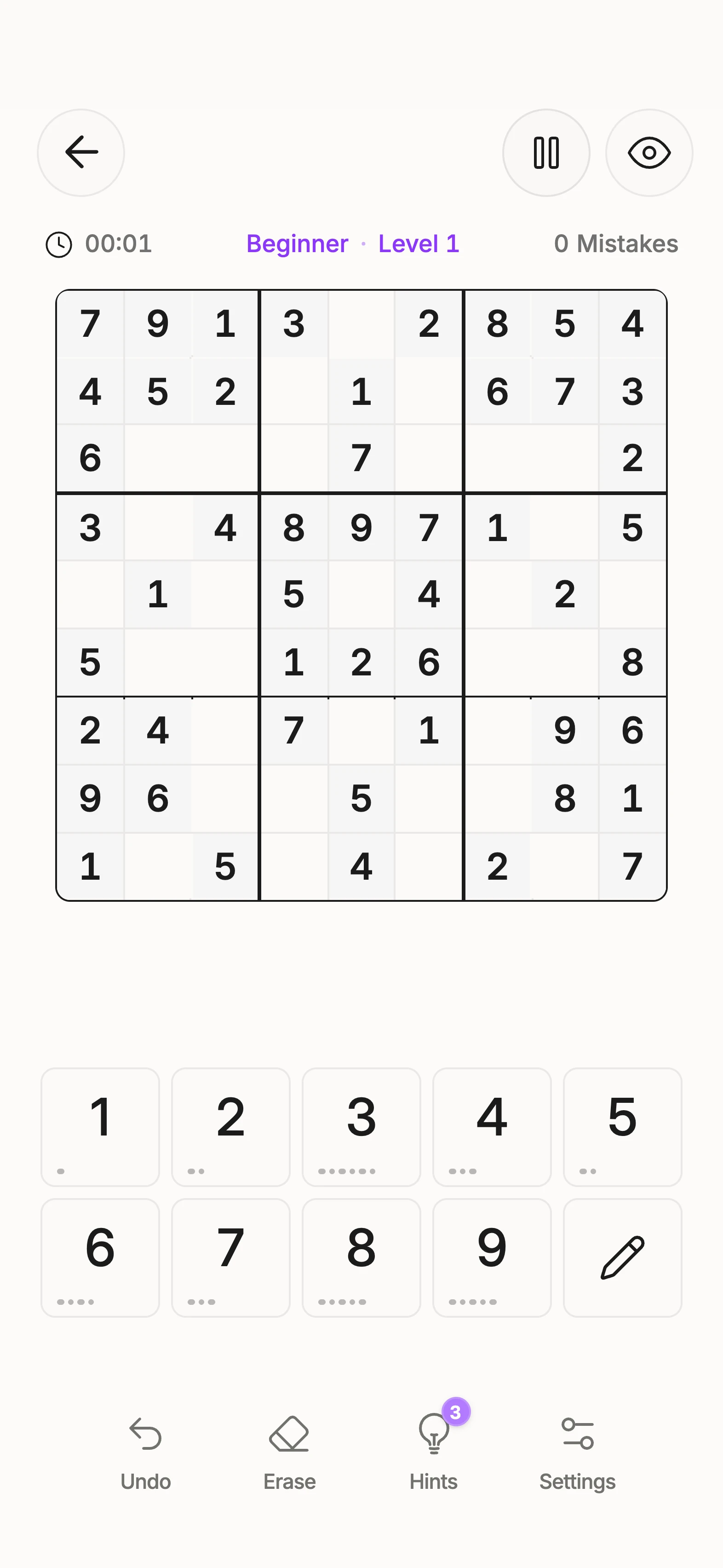
View the example grid
An ALS is a group of n cells in one area with n+1 distinct digits among their candidates. Two such groups can interact through a restricted common candidate.
Two cells see each other when they share a row, column or 3×3 box. An elimination needs the specific visibility relationships described in the reasoning.
An example from the app
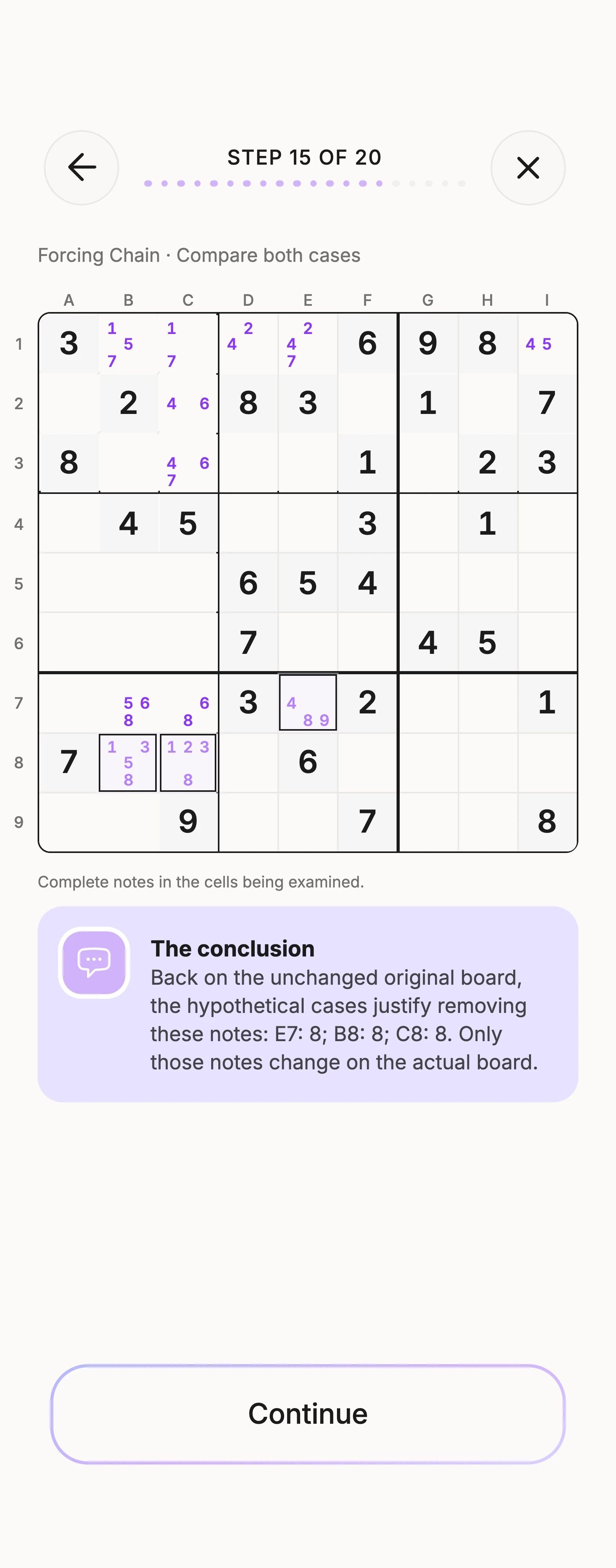
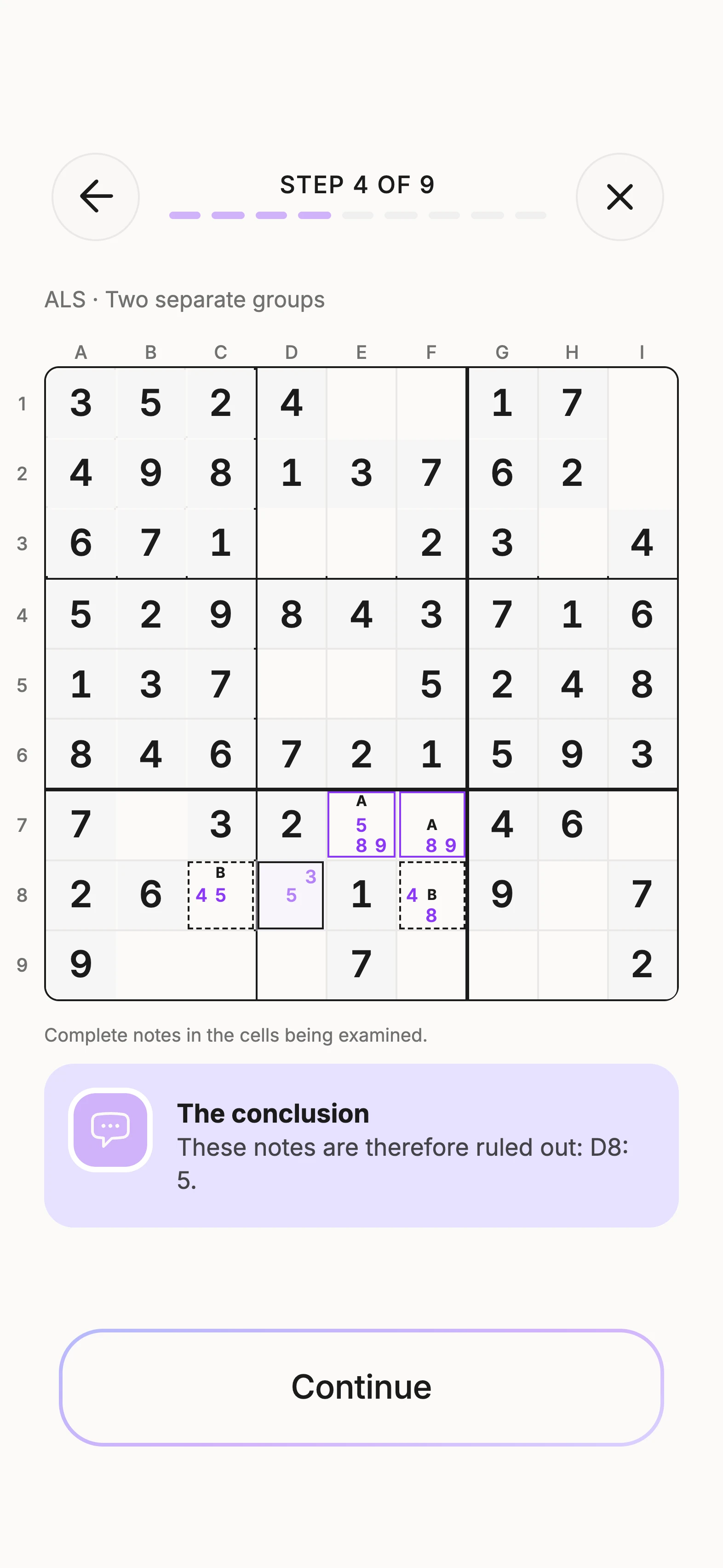
Group A: E7, F7. Group B: C8, F8.
Group A has 2 cells with 5, 8, 9. Group B has 2 cells with 4, 5, 8. Each group has exactly one more candidate digit than cells. They are two separate ALSs.
Every possible 8 in A shares a row, column or box with every possible 8 in B. So 8 cannot occur in both groups. At least one group must do without it.
Without 8, that group has exactly as many digits as cells and needs all of them, including 5. So 5 occurs in A or B. Cells sharing an area with every 5 position in both groups lose it.
These notes are therefore ruled out: D8: 5.
The image shows the candidates relevant to this step. A note being hidden does not mean it has been logically eliminated.
Practice the next step
In this ALS-XZ example the groups do not overlap. The linking candidate cannot appear in both groups at once. Another common candidate can be removed from a cell seeing all its positions in both groups.
In the app, follow the reasoning in the matching lesson and try a task yourself. With a new puzzle, always start from its actual candidate state.
Questions about ALS
Does n+1 count notes or distinct digits?
Distinct candidate digits. Repeated occurrences of one digit count only once for this condition.
Can an ALS use arbitrary cells across the grid?
No. Its n cells must share an area and contain exactly n+1 distinct candidate digits between them.
What is a restricted common candidate?
Every position for that digit in one group sees every position in the other. The digit therefore cannot appear in both groups together.
Can the two groups overlap?
They are disjoint in the ALS-XZ case explained here. The illustrated argument depends on those separate groups.
Must the target see every cell of both groups?
It must see every position of the digit being eliminated in both groups. Seeing one arbitrary cell from each is insufficient.
Keep practicing in Unisu
Download Unisu for iPhone or Android. Solve a puzzle or work through a guided lesson on the technique.